September 30, 2026 | Category: Investments

¿Cómo podemos ayudarte?
Búsquedas más populares
- Solicitud de documentos de cuentas de depósito y auto
- Horario y dirección de sucursales y ATH
- Número de Ruta y Tránsito
- Mi Banco Móvil – Mensajes de texto
- Cómo buscar estados de cuenta
- Hacer transferencias
- Redención PREMIA®
Descarga la aplicación móvil de Mi Banco Móvil hoy


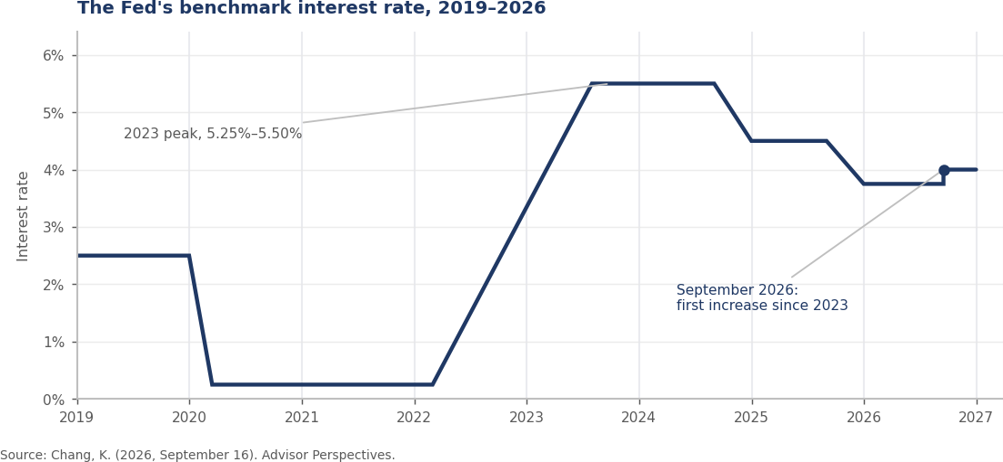
At its sixth meeting of the year, the Federal Open Market Committee, the group of Federal Reserve officials who set interest rate policy, voted unanimously to raise the federal funds rate by a quarter point to a target range of 3.75% to 4%. It is a notable moment: this is the first increase in the benchmark rate since 2023, and it reverses the direction of policy after the rate cuts of 2024 and 2025. In plain terms, the Federal Reserve has decided that the cost of borrowing needs to be modestly higher to finish the job on inflation.
The reasoning was straightforward. The economy is growing at a solid pace, consumers have kept spending, and businesses have kept investing. Hiring has held up, and the unemployment rate has barely moved over the past year. What has not cooperated is inflation, which remains elevated and still sits above the Fed’s 2% target. With the job market steady, the Committee judged that it had room to lean against rising prices, and officials signaled they now expect to hold rates somewhat higher through year-end than they had previously projected (Chang, 2026).
For investors, higher short-term rates tend to affect mortgage and loan costs, savings yields, bond prices, and stock valuations. Markets can also be repriced quickly as new data arrives ahead of the Fed’s next meeting on October 27-28. None of that changes what matters most. Policy cycles turn; well-built plans are designed to withstand them. Markets will continue to move faster than fundamentals—your plan should not.
Reference
Chang, K. (2026, September 16). Fed’s interest rate decision: September 16, 2026. Advisor Perspectives. https://www.advisorperspectives.com/dshort/updates/2026/09/16/feds-interest-rate-decision-september-16-2026
Important Disclosures
Investment products and services are offered by Popular Securities, LLC, a registered broker/dealer, member of FINRA and SIPC, and a registered investment adviser. Investment products are not insured by the FDIC, are not deposits or obligations of, nor guaranteed by Banco Popular de Puerto Rico, its affiliates and/or subsidiaries; they involve risk and may lose value, including the loss of the principal invested. This material has been prepared for informational and educational purposes only and does not constitute a solicitation for the retention, purchase, or sale of securities. Opinions and estimates are subject to change without prior notice.