August 11, 2026 | Category: Investments

¿Cómo podemos ayudarte?
Búsquedas más populares
- Solicitud de documentos de cuentas de depósito y auto
- Horario y dirección de sucursales y ATH
- Número de Ruta y Tránsito
- Mi Banco Móvil – Mensajes de texto
- Cómo buscar estados de cuenta
- Hacer transferencias
- Redención PREMIA®
Descarga la aplicación móvil de Mi Banco Móvil hoy


News of initial public offerings (IPOs) by well-known private companies typically makes headlines. The expected IPOs of SpaceX1, OpenAI and Anthropic are no exception in this respect.
What’s unusual about these highly anticipated IPOs is their size. SpaceX is reportedly seeking a valuation of $1.75 trillion to $2 trillion, while OpenAI and Anthropic are both expected to price their IPOs at valuations near $1 trillion or more.
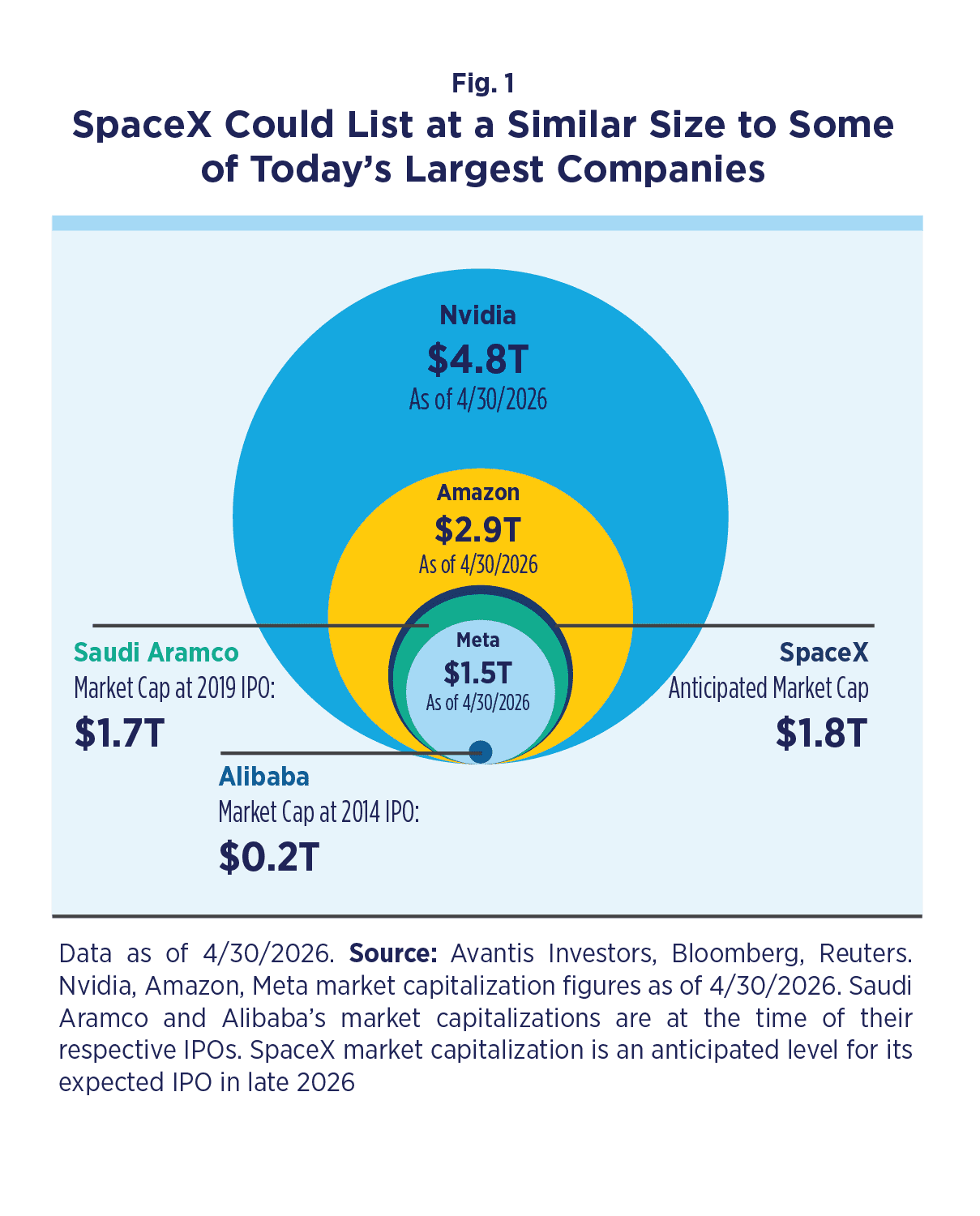
The current record valuation, or market capitalization, at IPO is $1.7 trillion for Saudi Aramco in 2019. Alibaba holds the mantle for the largest IPO on a U.S. stock exchange, with a market capitalization of about $169 billion.
SpaceX could become the largest IPO ever by total valuation and immediately jump into the top 10 of the world’s largest publicly traded companies .
For added context, Figure 1 shows how SpaceX, with a market capitalization of $1.8 trillion, would compare in size to the largest IPOs we’ve seen to date, as well as some of today’s largest publicly traded companies.
Should Investors Include IPOs in Their Portfolios?
It’s easy to see why there’s buzz about these companies going public, but whether they should be viewed as good investments when they hit the market is a separate issue.
Consider past high-profile IPOs from Facebook (now Meta) and Uber. Both companies managed widely used consumer products, and their IPOs were the first opportunities for everyday investors to own shares in these businesses.
Four months after the Facebook/Meta IPO in May 2012, the stock declined by more than 50% and took over a year to return to its IPO price.
Similarly, Uber saw its price slide by about a third in the first five months and also took more than a year to trade consistently above its IPO price.
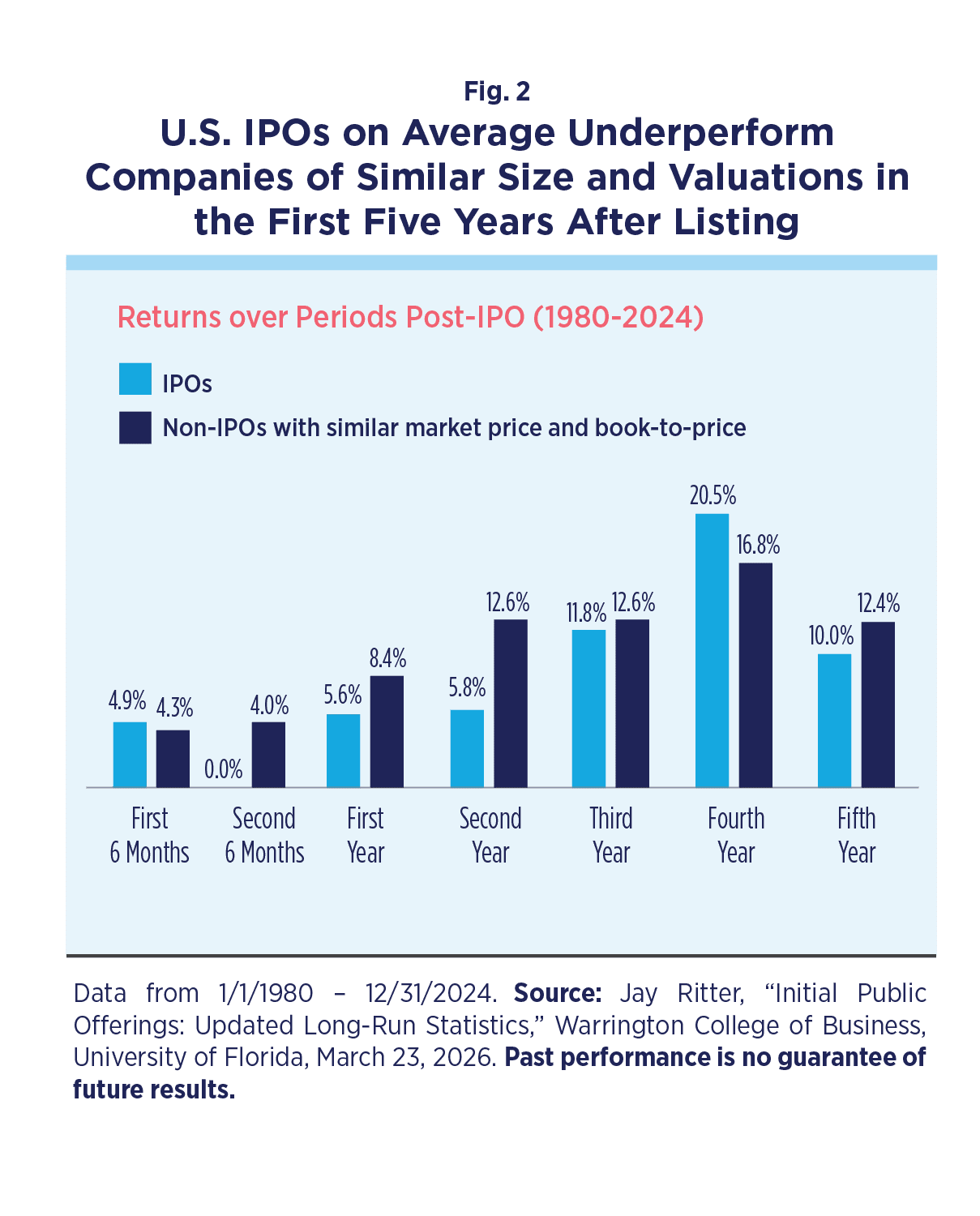
While these are just two examples of the thousands of IPOs over time, their results aren’t outside the norm. In fact, a broad body of research has shown that, on average, IPOs have historically underperformed for some time after listing relative to similar companies that have traded publicly for years.
Some have attributed this result to the expiration of shareholder lockups, which prevent company insiders from selling their shares until, typically, at least six months after an IPO. The theory is that once these previously restricted shares are made available for sale in the market, the additional supply creates downward selling pressure on the company’s stock price, leading to lower returns for IPOs in the first year after listing.
However, IPO underperformance generally persists beyond one year, as shown in Figure 2. Between 1980 and 2024, the average annualized return for IPOs over the five years after listing trailed already-listed peer companies with similar market capitalization and book equity-to-price characteristics by about 2%. The expiration of insider lockups may contribute to some short-term underperformance, but it doesn’t explain the longer-term outcomes.
One noticeable characteristic missing from the selection of listed peer companies for performance comparison is company profitability. This is important because if IPOs have much lower profitability than their already-listed peers, they should have lower expected returns.
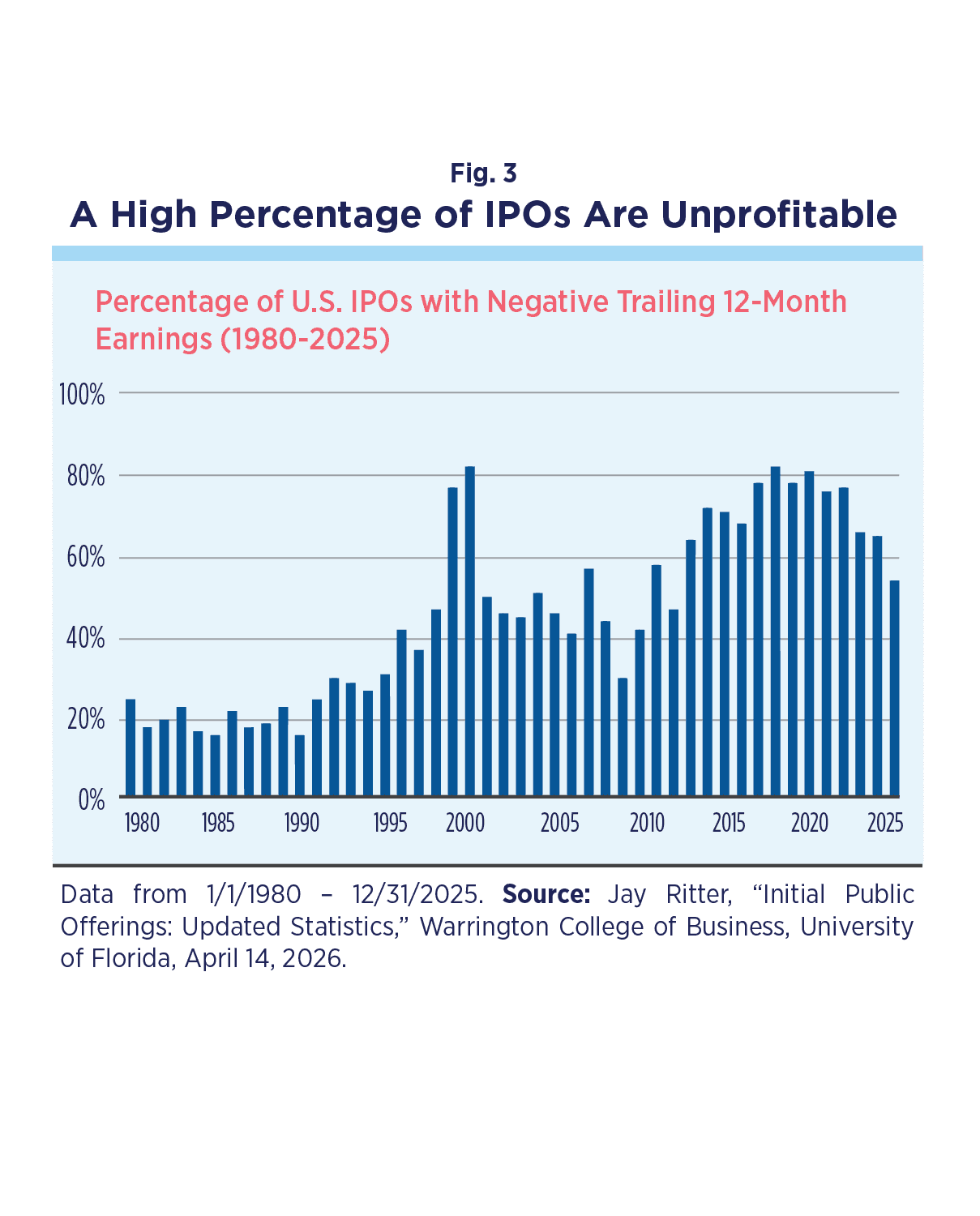
As it turns out, many IPOs were not profitable when they were listed. Figure 3 shows the percentage of IPOs with negative trailing 12-month earnings for each calendar year since 1980. This suggests many IPOs were likely listed at a similar size and book-to-price to older public companies, but with much lower profitability, which implies lower expected returns.
The takeaway is not that all IPOs are therefore inherently low-expected-return investments. We need a full set of financials — not just book value and price — to assess their expected return. The price of the company, its equity and its profits are all critical for understanding how an IPO compares to other companies and what allocation, if any, it should have in a portfolio.
How Are Index Providers Responding, and How Could It Affect Investors?
A subtopic within the news about the upcoming mega-cap IPOs is how index providers are preparing for their arrival in the market. Of note is a recent proposal from S&P that would drop its long-held requirement that companies trade publicly for at least 12 months before being admitted to the S&P 500® Index.
For companies among the largest 100 by valuation, the proposal would also eliminate their current requirement to have one full year of positive profits. Reporting indicates the profitability restriction would remain for companies below the 100 largest.
S&P’s current criterion famously prevented Tesla, which went public in 2010, from being added to the S&P 500 until 2020, even though it was already among the 100 largest U.S. companies. Public knowledge of OpenAI and Anthropic earnings suggests that each would likely fail to meet the current profitability screens if S&P were to make no changes to its methodology.
Other index providers, such as Russell, MSCI and Nasdaq, are currently evaluating their index rules as well. It’s yet to be determined exactly what changes will be made and how quickly the mega-cap IPOs will be included. There are also considerations for the weight each company could have in each index. Indices would likely link their weights to free-float market capitalization, which represents a fraction of a company's shares available for public trading (i.e., excluding restricted shares held by insiders, other strategic investors, etc.).
What’s clear is that index providers are working hard to include these companies in widely tracked indexes sooner rather than later. This has important implications for investors.
When new companies are added to the indexes tracked by an index fund, the fund must quickly acquire shares of those companies to continue closely replicating the index's returns. Anytime there is a set of forced buyers (i.e., index funds) that want shares held by a group of non-forced sellers (i.e., non-index fund investors), there must be an incentive for that transfer to occur.
This can result in index funds paying temporarily inflated prices for new additions to the index they track. This is simply a liquidity issue, but it does negatively impact index funds as they lock in positions at higher prices. Further, adding a company with a large weight means selling others to make room for it, so the rebalancing involves more than just the added company.
For non-index funds, avoiding purchases of companies around the time they are added to popular indexes is expected to add value by steering clear of elevated prices driven by heightened liquidity demands.
Mega-IPOs: Look Past the Hype and Focus on Fundamentals
When large, well-known companies announce their plans to go public, expect to see significant media coverage. These events are newsworthy, especially when they involve companies that are larger than most existing public firms and may introduce new opportunities related to popular investment themes.
As investors, the hype should not stop us from evaluating the merits of these opportunities through a sound framework. If the goal is higher than expected returns, we need to consider the full financials of these companies, including their balance sheets and cash flows, as well as their prices.
Whether we are dealing with IPOs or companies that have long traded in the market, those with attractive prices relative to their financials are expected to do better over the long term.
Additionally, strategies that are not strictly tied to indexes can exercise greater flexibility in implementation, whereas index-tracking approaches, by their mandate, are wed to buy-and-sell decisions determined by index houses in their methodology. Flexibility can prove advantageous in these scenarios. We believe all these considerations should be weighed when constructing asset allocations.
Copyright 2026 American Century Proprietary Holdings Inc. All rights reserved.
Liquidity describes the degree to which an asset or security can be quickly bought or sold in the market without affecting the asset's price.
Investment in an IPO can involve heightened risk compared to seasoned securities and include the possible loss of principal. IPOs typically have a limited operating history, less publicly available information and no established market price prior to the offering. This may lead to price volatility, especially in early trading and post-IPO due to “lockup expirations” that may pressure prices.
1At the time this article was written (May 2026), SpaceX had not yet completed its initial public offering (IPO) registration process. While SpaceX has since gone public, the educational content and investment considerations discussed in this article remain relevant for evaluating IPOs and other high-profile public offerings.
The content of this material has been prepared for informational purposes and does not constitute tax, legal, or accounting advice. Banco Popular de Puerto Rico, its subsidiaries, and/or affiliates do not provide tax, legal, or accounting advisory services.
The opinions expressed are not necessarily those of Avantis® Investors or Popular Securities, LLC. This information is for educational purposes only and is not intended as investment advice. Popular Securities is not affiliated with this article and makes no representations or warranties as to the accuracy or completeness of the content contained therein. Neither the information nor the opinion expressed constitute a solicitation by Popular Securities, LLC for the retention, purchase, or sale of securities.
Avantis® Investors and Popular Securities, LLC. are separate and unaffiliated firms, and neither is responsible for the products or services of the other. The views and opinions expressed are for informational and educational purposes only as of the date of writing and may change at any time based on market or other conditions and may not come to pass. This material is not intended to be relied upon as investment advice or recommendations, does not constitute a solicitation to buy or sell securities and should not be considered specific legal, investment or tax advice.
Investment products and services are offered by Popular Securities, LLC, a registered broker/dealer, member of FINRA and SIPC. Investment advisory services are offered through Popular Securities, LLC, a registered investment advisor. Popular Securities, LLC is a subsidiary of Popular, Inc. and an affiliate of Banco Popular de Puerto Rico. Popular Inc. and Banco Popular de Puerto Rico are not registered broker-dealers, nor registered investment advisors. Popular One is an integrated financial services program that revolves around you through which Popular Securities services are offered. Investment products are not FDIC insured, are not deposits or obligations of, nor guaranteed by Banco Popular de Puerto Rico, its affiliates and/or subsidiaries; they involve risk and may lose value, including the loss of the principal invested.